
 I have a short piece on ‘When Does International Law Work?’ out today in the Globe, the magazine of the Graduate Institute in Geneva. The piece is part of a broader forum on ‘International Law: Future Challenges’ which features contributions by a number of the international law faculty working at the Institute and makes for a very interesting read. The magazine is available online here.
Category Archives: Uncategorized
The Structure of Postnational Authority
 I have a paper up on SSRN on “The Structure of Postnational Authority“, which tries to develop some of the ideas about ‘liquid authority’ I have been talking about for some time. The abstract is below – comments always welcome!
Abstract: Analyses of authority in the global realm have risen to greater prominence in recent years but many of them employ a model of ‘solid’ authority borrowed from the domestic context that focuses primarily on commands issued by single institutions. This paper argues that such approaches tend to underestimate the presence of authority in global governance and to misunderstand its nature, leading to skewed accounts of the emergence of authority and the challenges it poses. The paper develops a broader conception of authority which also includes ‘liquid’ forms – forms characterized by informality, substantive groundings, multiplicity, and significant dynamism. It outlines how such a broader account can help us to reframe the problématique of postnational governance, especially by leading us away from statist frames when confronted with the particular difficulties of authority structures which often have pervasive effects but are hard to locate and tograsp.
The paper is available at http://ssrn.com/abstract=2564579.
CfP: ICON•S 2015 “Public Law in an Uncertain World” in New York City
 The International Society of Public Law (ICON•S) invites submissions for papers and fully-formed panels for its 2015 Conference on “Public Law in an Uncertain World”. The Conference will take place in New York City, on July 1-3, 2015, at the New York University School of Law.
The purpose of this conference is to explore and evaluate the function and limits of public law in our uncertain world in relation to war and peace, human rights, religion, state-building, constitution-making, formal and informal institutional change, revolutionary movements, national security as well as but not limited to the economy, the environment and the challenge of new technologies.
ICON•S welcomes both individual papers as well as proposals for fully-formed panels, from both senior and junior scholars (including advanced Ph.D. students) as well as practitioners. Proposals may focus on any theoretical, historical, comparative, empirical, doctrinal, philosophical or practical perspective related broadly to public law, including administrative law, constitutional law, criminal law, or international law in all of their possible domestic, transnational, supranational, international and global variants related to the 2015 Conference theme.
All submissions must be made on the ICON•S website by April 10, 2015. More information is available at http://icon-society.org/conference/2015.
Assistant Professorship in International Law: Graduate Institute, Geneva
 The Graduate Institute for International and Development Studies, which I’ll be joining next month, has advertised an assistant professorship in international law, with potential specializations in international economic law, the protection of human dignity, international environmental law, or transnational law. The deadline for applications is 15 February 2015; more details can be found here. Please forward this to whoever might be interested – we’re looking forward to great applications!
The Public and the Private in Global Governance – Barcelona Workshop on Global Governance 2015

Later this week, IBEI and ESADE will host the 2015 Barcelona Workshop on Global Governance on the topic of ‘The Public and the Private in Global Governance‘. The workshop brings together an interdisciplinary group of scholars; speakers include Andrew Hurrell (University of Oxford), Benedict Kingsbury (New York University) and Jonas Tallberg (Stockholm University). More information (also on how to register) can be found here; the programme is available here.
Barcelona Workshop on Global Governance
The Public and the Private in Global Governance
15 & 16 January 2015 – IBEI & ESADEGeo
Global governance is constructed by both public and private actors. Governments have created international institutions and transgovernmental networks; companies have established self-regulatory structures; civil society and business organizations have been active in norm-setting and monitoring. They have joined forces in various hybrid organizations, which collaborate and compete with each other, and all perform functions in the many regulatory spaces that include institutions and actors of various origins. At the same time, many privately-created bodies claim to provide public goods, while many institutions of public origin are criticized for pursuing private gains or for being strongly influenced by private interests. As a result, the boundaries between public and private in global governance have become blurred, and the classical public/private distinction – central to structuring our understanding of domestic government – is under increasing pressure. On this background, the 2015 Barcelona Workshop on Global Governance asks how ‘the public’ and ‘the private’ are related in current structures of global governance.
International Law and Time: Call for Papers
 The International Law Department of the Graduate Institute of International and Development Studies in Geneva, which I will join next month, is opening a call for papers to explore the theme of ‘International Law and Time‘ at a conference to be held on 12-13 June 2015. The deadline for abstract submissions is 15 February 2015. The conference is open to both junior and senior international law scholars and practitioners, and the organizers especially encourage current and recent doctoral students to apply with a submission. The theme and envisaged panel topics are very promising, and I hope there will be many abstract submissions. The call for papers is here, and more information on the conference here.
The Backlash against International Courts
 I have a new blog post out, over at Verfassungsblog and Völkerrechtsblog, on ‘The Backlash against International Courts’. It is part of a broader symposium on tensions between domestic and international law. My post takes recent challenges of international courts by domestic (jusdicial and political) actors as a starting point for inquiring a bit further into whether they form part of a trend, why they have come about, and how to address them normatively. I largely read these challenges as responses to an ever stronger role of international courts – the expansion of their scope of action to include many controversial issues of domestic law and politics. Such responses are sometimes parochial but they need not always be seen in a negative light: they are efforts at recalibrating a relationship in which domestic democratic processes can become marginalized if international rules prevail as a matter of course. Have a look!
Better together or happy apart? Independence Movements in Europe: Video
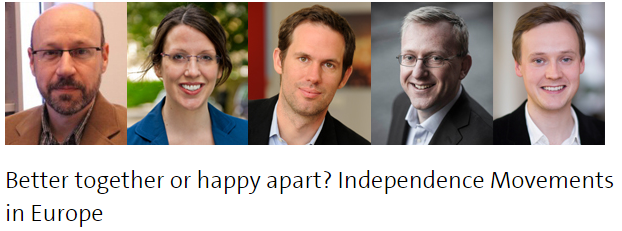 As I posted before, two weeks ago we had an interesting discussion on independence movements in Europe at the Hertie School of Governance in Berlin, spurred by the recent (formal and informal) referenda in Scotland and Catalonia. I gave a short introductory talk, trying to frame questions about the character of these movements, the legal framework of aspirations for independence in Europe, their normative assessment, and the political challenge they pose. The debate, moderated expertly by Mark Dawson from the Hertie School, included Eve Hepburn from Edinburgh, Jaume Lopez from Barcelona and Steven Blockmans from Amsterdam and Brussels. For those who had to miss the event, videos are now available here and here.
Better together or happy apart? Independence Movements in Europe
 On 19 November I’ll give a short impulse speech to open a debate on independence movements in Europe at the Hertie School of Governance in Berlin, my former academic home (and where I’m a fellow now). The debate brings together a number of good speakers, from Catalonia, Scotland, Brussels and Berlin. We’ll discuss questions such as: What are the lessons of the Scottish referendum for other regions in Europe? How might the upcoming battle over Catalonia’s constitutional future resolve itself? What role might the EU play in forwarding or limiting the ambitions of independence movements? Given the recent salience of the issue in Scotland and now in Catalonia, this promises to be interesting and (hopefully) controversial event. Join us if you can! Details are here.
Law and Legitimacy in the Spanish Constitutional Conflict
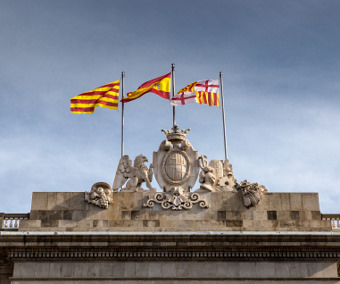 Neus Torbisco and I have a post up at EUROPP, the LSE Blog on European Politics and Policy, on Law and Legitimacy in the Spanish Constitutional Conflict, arguing that ‘using Spanish law to block Catalonia’s independence consultation may simply encourage Catalans to construct their own ‘alternative legality’’. Ahead of this weekend’s consultation (and today’s expected new intervention of the Spanish constitutional court), we thought it would be good to clarify the idea of ‘law’ and ‘legality’ somewhat. Have a look!
 nico krisch