Category Archives: Uncategorized

Capacity and Constraint: Governance Through International and Transnational Law

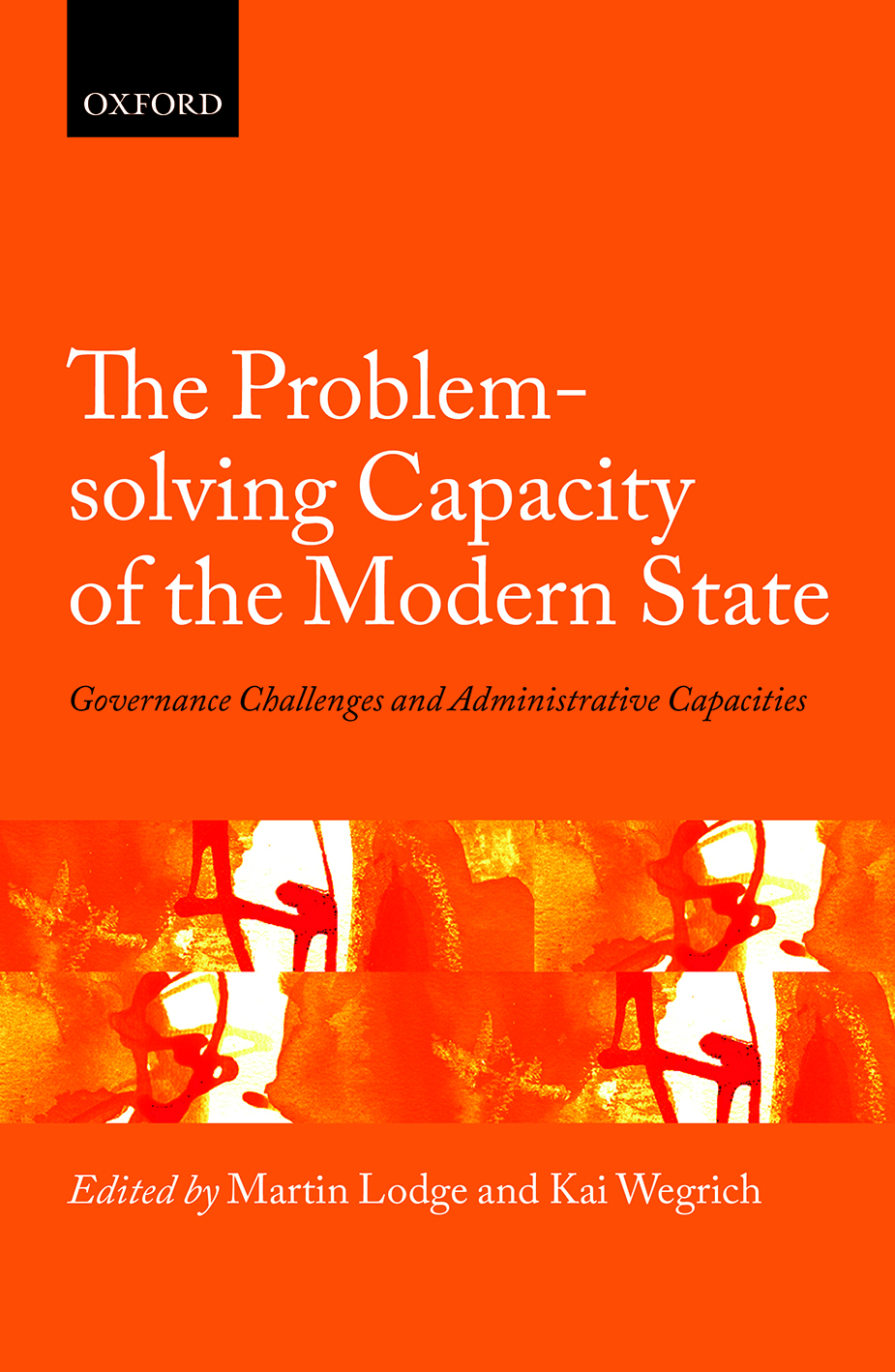
Cover high resolutionA chapter of mine on ‘Capacity and Constraint: Governance Through International and Transnational Law’ has just appeared in a volume, edited by Martin Lodge and Kai Wegrich, on The Problem-solving Capacity of the Modern State: Governance Challenges and Administrative Capacities (OUP, 2014, here). This is an interesting volume, the companion volume to the Governance Report 2014 of the Hertie School of Governance (which can be found here).

And here is also the abstract of the chapter (an earlier draft of which is available on SSRN here):

Transboundary problems have provided serious challenges for states’ governance capacity for long. As a result, the modern state has not only begun to adapt its own administrative and regulatory structures; it has also come to rely increasingly on effective institutional structures for cooperation and governance on a regional and global scale. The classical instrument for international cooperation, international law, can only provide such structures under certain conditions and within strict limits. Governments have therefore turned to alternative forms of transnational ordering, which in some cases have indeed led to more effective decision-making – key among them formal international institutions, informal government networks, extraterritorial regulation, and links with private forms of regulation. However, all of these tools come with drawbacks – some are more effective than others, and the more they are effective, the more they tend to entail a loss of control for national governments, regulators and administrators. Domestic authorities have sought to readjust and develop new forms of influence in transnational regulatory contexts, some of them resulting in asymmetrical structures that increase the capacity of some countries’ institutions while constraining those of others. In this paper, I analyze the different forms of transnational law- and rule-making with respect to their varying impacts on, and links with, domestic governance institutions, and I place a particular focus on the most prominent example – the rise of informal institutions and transgovernmental networks in global regulation.

 

Transnational Standards in the Domestic Legal Order

Univ of AmsterdamLater this month, I’ll have the pleasure to speak at a workshop in Amsterdam on ‘Transnational Standards in the Domestic Legal Order: Authority and Legitimacy’, organized by Machiko Kanetake and Andre Nollkaemper as part of the project on the ‘Architecture of Postnational Rulemaking’ at the University of Amsterdam. The workshop takes place on 24 October and will bring together a great group of scholars. The programme as well as registration details can be found here.

Comparative International Law

800px-UN_Members_FlagsI recently presented a paper at the Sokol Colloquium at the University of Virginia, dedicated to the study of “Comparative International Law” and part of a project driven by Paul Stephan, Pierre-Hugues Verdier, Mila Versteeg and Anthea Roberts. The Colloquium brought together a fascinating variety of approaches to the topic; the programme can be found here. My own paper, “The Many Fields of International Law”, tried to outline some theoretical and methodological groundings for engaging in the analysis of comparative international law and applied it to the particular case of German international law academia. The paper is in early draft form, too early to post, but if someone is interested, please let me know and I’m happy to share it.

The Public and the Private in Global Governance – Barcelona Workshop January 2015

BCNWGGBarcelona Workshop on Global Governance

The Public and the Private in Global Governance

15 & 16 January 2015 – IBEI & ESADEGeo

Call for Papers

Global governance is constructed by both public and private actors. Governments have created international institutions and transgovernmental networks; companies have established self-regulatory structures; civil society and business organizations have been active in norm-setting and monitoring. They have joined forces in various hybrid organizations, which collaborate and compete with each other, and all perform functions in the many regulatory spaces that include institutions and actors of various origins. At the same time, many privately-created bodies claim to provide public goods, while many institutions of public origin are criticized for pursuing private gains or for being strongly influenced by private interests. As a result, the boundaries between public and private in global governance have become blurred, and the classical public/private distinction – central to structuring our understanding of domestic government – is under increasing pressure. On this background, the 2015 Barcelona Workshop on Global Governance asks how ‘the public’ and ‘the private’ are related in current structures of global governance. Key questions involve:

  • Does it make sense to maintain a distinction between public and private authority, and if so, how ought ‘publicness’ to be reformulated for the global sphere? What could take the place of the public/private distinction for structuring accounts of legitimacy and accountability in global governance?
  • Do the authority and legitimacy of global governance, both normatively and sociologically, depend on the ‘publicness’ of its institutions?
  • How do institutions (including privately-created ones) generate, or seek to generate, ‘publicness’ in their rhetoric, procedures and accountability mechanisms, and with what success?
  • How do private actors, both national and transnational, participate in global governance regimes? What patterns of interaction exist between privately- and publicly-created institutions?
  • What success can the construction of a ‘global public law’ as a law of global governance have?

The Barcelona Workshop on Global Governance is a venue for the study of global governance – its structure, effects, and problems – from an interdisciplinary perspective, bringing together scholarship from international relations, law, sociology, anthropology, political theory, public administration and history. Its 3rd edition will be held on 15 & 16 January 2015 in Barcelona. Confirmed practitioner speakers include Narcis Serra (former Spanish Defense Minister and Deputy Prime Minister) and Javier Solana (former NATO Secretary General and EU High Representative for Common and Foreign Security Policy). Confirmed academic keynote speakers include Andrew Hurrell (University of  Oxford) and Jonas Tallberg (Stockholm University).

We invite abstract proposals from interested scholars from all disciplines. Proposals should not exceed 500 words in length. Preferred format for all submissions is PDF. Please send your proposal as an attachment to info@bcnwgg.net and insert “Submission: Barcelona Workshop on Global Governance” as the subject line of themessage. The deadline for abstracts is 29 September 2014. All proposals will undergo peer review and notifications of acceptance will be sent out by 22 October 2014. Full papers are expected to be delivered by 8 January 2014 for circulation among participants. More information on the workshop, also on previous editions, is available here.

Investment Arbitration in TTIP

TTIP-MotivI have joined a submission to the EU consultation on investor-state dispute settlement (ISDS) in the planned Transatlantic Trade and Investment Partnership (TTIP). The submission, prepared by Harm Schepel, Gus van Harten, Horatia Muir Watt and Peter Muchlinski, raises a number of serious concerns, which I hope will attract greater attention in the debate over the coming months. It can be accessed here.

Cambridge Workshop on Governance and Globalization

Lauterpacht CentreLater this week, I will be at a workshop at the Cambridge Lauterpacht Centre on ‘Governance and Globalization: International and European Answers’, giving a paper on ‘Legalities and Legitimacies in Global Governance’ among a host of luminaries in international law and international relations. Information on the workshop is here.

ICON-S Conference

ICONS pictureLast week, I was at the splendid inaugural conference of the International Society of Public Law (ICON-S) in Florence, presenting my paper on ‘Pouvoir Constituant and Pouvoir Irritant in the Postnational Order’. More information and videos of some of the sessions, especially the plenary ones with talks by Jeremy Waldron, Robert Keohane, Joseph Weiler and Ruth Rubio Marin are available here.

Subsidiarity in Global Governance: Workshop Programme

The programme for the inter-disciplinary workshop on ‘Subsidiarity in Global Governance’, which I am convening, with Markus Jachtenfuchs, on 19 & 20 June 2014 at the Hertie School of Governance in Berlin is now available here: Subsidiarity 2014- Program 2014-06-04. The idea of the workshop is below. Anybody interested in attending please contact Andrea Derichs at derichs@hertie-school.org.

Workshop Idea

Global governance is more influential than ever, but it is also under ever greater challenge. It reaches deep into domestic politics and law in a growing number of issue areas, and public discourses increasingly reflect this fact. As a result, the relationship of different layers of law and politics has gained greater salience. Global governance is not necessarily a solution any more but also a problem; as domestic contestation of global governance is growing, questions about the appropriate site of decision-making on issues with transboundary impact have become central.

One of the most common frames for these questions, both analytically and normatively, is the notion of ‘subsidiarity’. Subsidiarity is commonly seen to have at its core the principle that decisions ought to be taken at the lowest institutional level unless there are good reasons to shift them upwards. Views on what qualifies as such ‘good reasons’ differ – greater efficiency, respect for principles of justice, or the realization of cosmopolitan democracy are among the candidates. Yet the key presumption of lower-level decision-making appears as an attractive starting point for thinking about, and designing, the vertical distribution of powers in global governance – it reflects the idea that self-government is typically more meaningful on a smaller scale, and it requires any upscaling of powers to be guided by principle rather than mere political fact.

However, the conditions for subsidiarity in the international system are different from the domestic context: there is no strong central government against which subsidiarity could be evoked but often weak institutions with a low problem-solving capacity. Strengthening subsidiarity might thus strengthen national sovereignty and weaken governance, justice and democratic accountability at the global or regional level. Finally, subsidiarity at work may be difficult to identify because actors do not directly refer to it but only struggle over its key element – that power should only be exercised at a higher level if there are good reasons for it.

Against this backdrop, in this workshop we are primarily interested in four questions relating to subsidiarity:   To what extent can we identify subsidiarity as a guiding principle of global governance and law? Is it normatively more attractive than potential alternative principles for the distribution of powers? What are the potential and limitations of subsidiarity as a guideline and constraint for political action in the global realm? How is subsidiarity used in discourses and processes of contestation about vertical power-sharing in global governance and law?

The workshop brings together around twenty scholars of law, politics and political theory for an in-depth, two-day exploration of these themes.

The Decay of Consent: International Law in an Age of Global Public Goods

AJIL 2014 ToCInternational law’s consent-based structure is often seen as inadequate for solving global public goods problems. Many commentators therefore project a turn toward nonconsensualism. This article focuses on three issue areas—internationalantitrust, climate change, and terrorism financing—to analyze whether we can observe such a turn. In the picture that emerges, international law retains much of its consensual character but is increasingly sidelined in favor of other, especially informal and unilateral, modes of governance in which consent plays a more limited role and hierarchy is often pronounced.

Published in American Journal of International Law 108 (2014), 1-40. Access via JSTOR here. Download a pre-print version here.